
 TR
TRBIOSECURE Biobank
Sample mapping and barcoding for biobanks and research laboratories: tank, rack, box and position addressing, cryogenic labeling, chain of custody and storage condition monitoring.
AvailableThe value of a biobank is not measured by how many samples sit in its freezers but by how quickly it can prove where a given sample came from, what was done to it, exactly where it is now, and who is accountable for it. Spreadsheets work for one researcher and one collection; with several users, several freezers and an external audit, the gap between the record and physical reality widens quickly.
Location hierarchy
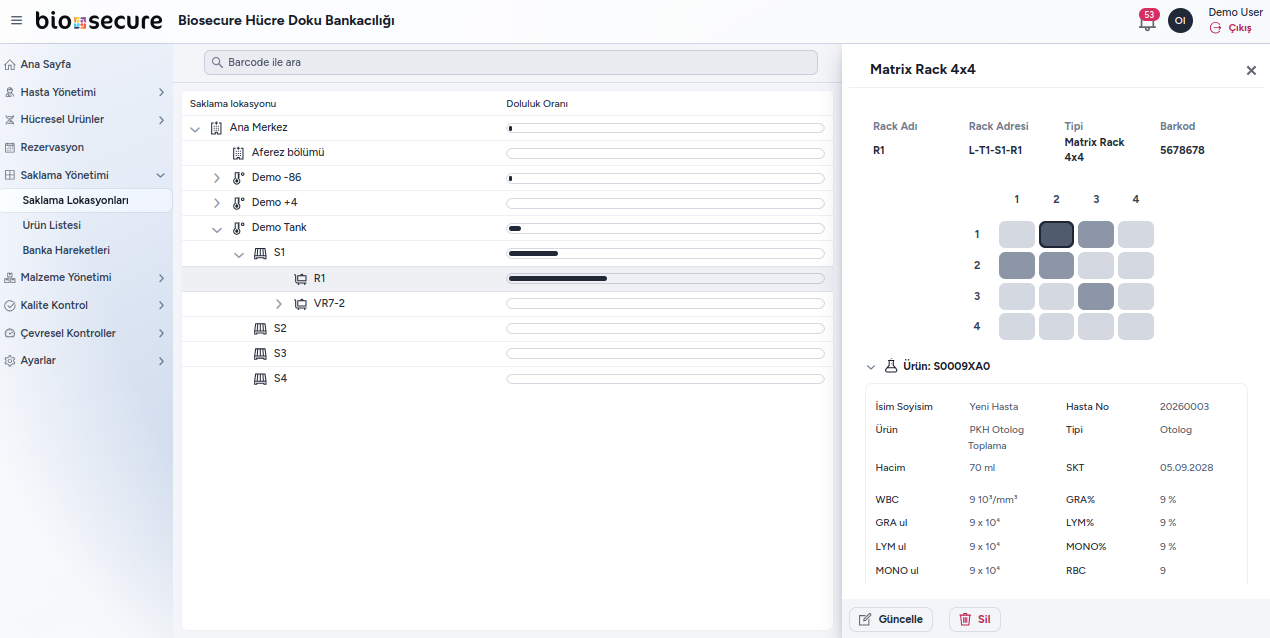
Storage is modeled as freezer or tank, then shelf or tower, rack, box and grid position. Box formats are standardized across the laboratory so that a coordinate means the same thing everywhere. The software presents this as a visual map: occupancy is visible at a glance and a suitable free position is proposed for a new sample.
Labels that survive the cold
- ISBT 128, QR and 2D Data Matrix cryogenic label printing
- Compatible with Thermo, Micronic, Matrix and FluidX tube and rack formats
- Handwritten labels degrade under frost, condensation and repeated freeze-thaw cycling; printed cryogenic labels do not
Chain of custody
Every significant event in a sample's life is recorded: collection, processing, thaw, transfer and destruction. Quarantine, approval, release and disposal are enforced as state transitions rather than conventions, and each transition is written to the audit trail with the user, time and reason.
Standards
The data model follows ISO 20387 process requirements for end-to-end traceability and chain of custody, and the operational guidance in the ISBER Best Practices for Repositories. For laboratories pursuing accreditation, the records an assessor asks for are produced by the system rather than assembled for the assessment.
Storage conditions
Freezer temperature, liquid nitrogen level and room oxygen are monitored through GE-MON and linked to sample locations, so a temperature excursion produces a list of affected samples rather than an investigation.
Talk to our team
Send us your storage layout and sample volumes and we will propose an addressing scheme.